 EveryGen AI
EveryGen AI 分镜指南:用 GPT-Image-2 创作九格
用 EveryGen AI 规划九格分镜。定义镜头序列,检查角色与道具连续性,以完整提示词作为起始简报。
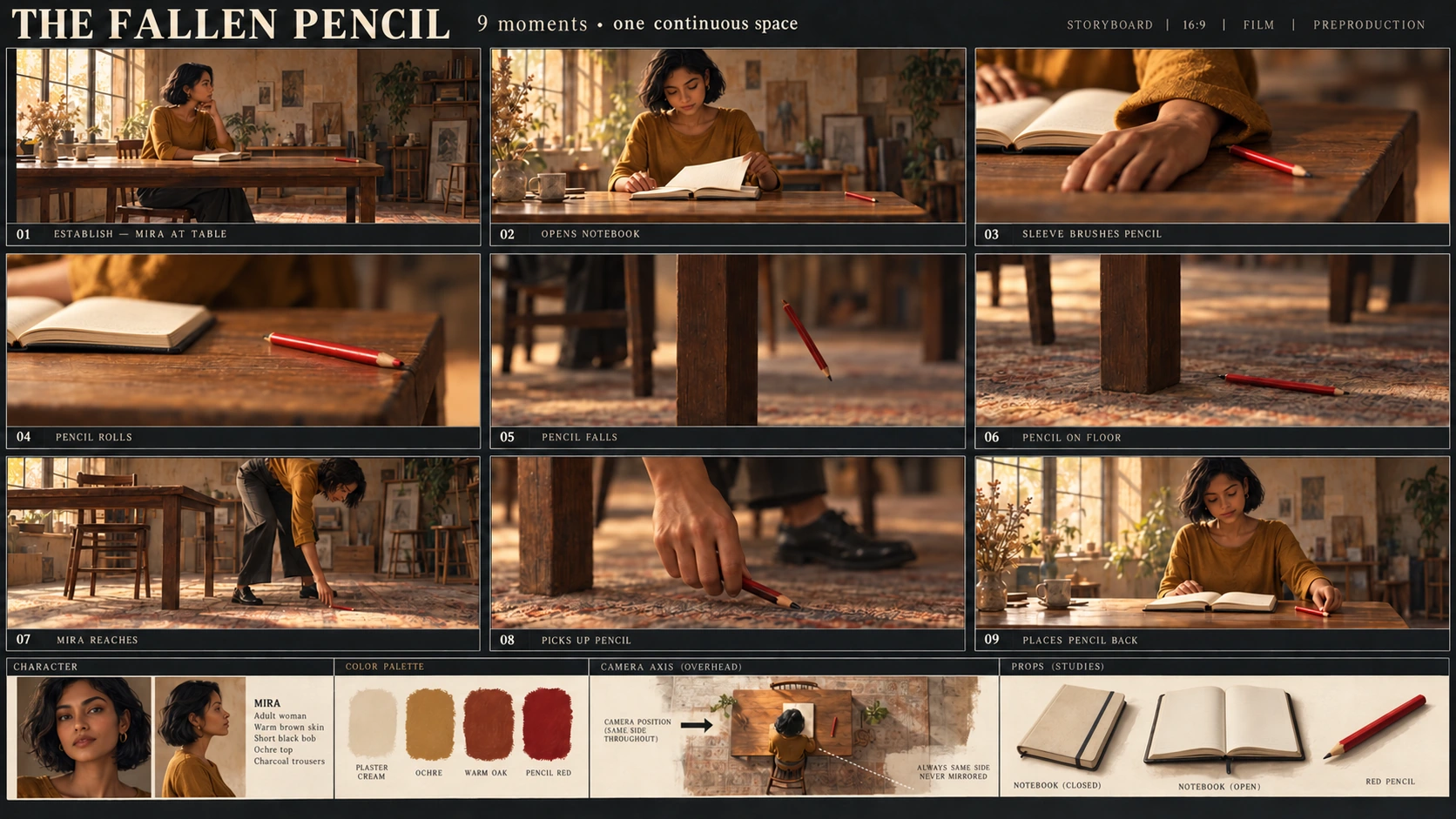
EveryGen AI 分镜审查既关注外观,也跟随动作。衣袖意外碰铅笔,与手指主动推不同;铅笔落在桌腿旁,不应重新出现在桌中央下方。
本 EveryGen AI 演练安排一个小事件:Mira 打开笔记本,意外碰掉桌上铅笔,捡起并放回。 交付一张九格图片及动作计划。
插图是 Codex 生成教学素材,不是 EveryGen AI 测试输出。它们展示场景参考、教学候选中观察到的接触错误,以及聚焦修订。
1. 定义角色、环境与参考图作用
让场景足够简单,方便检查。
EveryGen AI 简报中,Mira 为原创成年女性,暖棕肤色、黑短波波头、赭色长袖上衣与炭灰裤。她在观众左侧坐着,朝向木桌;有一把木椅、一本奶油色笔记本及一支红铅笔。
起始状态为笔记本合上,铅笔靠近桌右边缘。
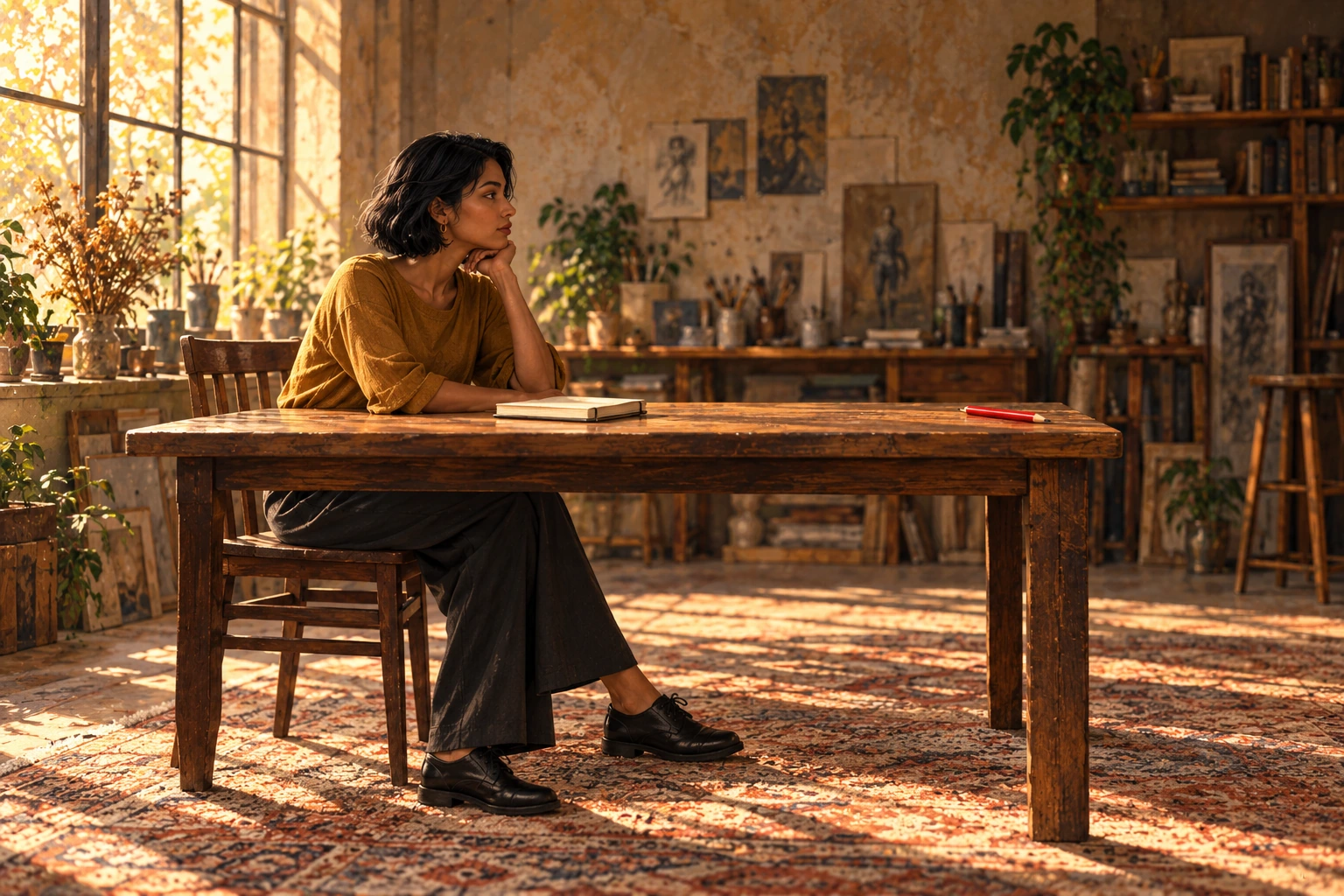
Codex 生成教学参考,确定 Mira 外观与起始布局。不是 EveryGen AI 输出。
EveryGen AI 参考定义外观与初始安排。动作计划必须解释何时打开本子、什么碰到铅笔,以及 Mira 去哪里捡它。
从 Text to Image 开始 EveryGen AI 流程。观看插图不等于附加它:在提示词描述角色和房间。后续 Image to Image 修订时,上传实际参考文件。
2. 生成九幅图前,写九个动作状态
按从左到右,再从上到下阅读:
第一行 01–03,第二行 04–06,第三行 07–09。
StudioBinder 解释如何在镜头表组织动作,并记录构图与相机详情。本 EveryGen AI 练习还需记录铅笔位置与笔记本状态。
| 格号 | 动作与建议构图 | 必需状态 |
|---|---|---|
| 01 | 宽景:Mira 坐在桌旁,准备开始。 | 笔记本合上,一支红铅笔靠近桌右边缘。 |
| 02 | 中景:她打开本子。 | 本子打开,铅笔仍在桌面。 |
| 03 | 特写:调整书页时,袖口碰到铅笔。 | 衣袖接触;手指没有推铅笔。 |
| 04 | 特写:铅笔滚向右边缘。 | 铅笔仍在桌面,接近边缘。 |
| 05 | 细节:铅笔下落。 | 铅笔在空中,位于可见右桌腿的观众右侧。 |
| 06 | 低位细节:铅笔落地。 | 铅笔在同桌腿紧靠右侧的地板上。 |
| 07 | 中景:Mira 离开椅子,走到桌右端,弯腰伸空手。 | 铅笔仍在落点,她还没捡起。 |
| 08 | 手部细节:她举起铅笔。 | 手中一支,地上没有重复铅笔。 |
| 09 | 中景:Mira 回座,把铅笔放在本子旁。 | 本子仍打开;桌上一支铅笔,地上没有。 |
EveryGen AI 审查用可见右桌腿连接第 05–08 格。“右”指同侧相机各视图内的右,不是格子在整张纸的位置。
EveryGen AI 这些格代表九个插画时刻。若干格以后可能共用连续镜头;编号不要求每格之间都切镜。
3. 在 EveryGen AI 设置整张图
打开 EveryGen AI,规划九格视觉序列。
已检查 EveryGen AI 界面为 Text to Image、GPT Image 2、Auto、1K、JPEG 与 x1。明确将 Auto 改为 3:2。
| 设置 | 本例选择 |
|---|---|
| 模式 | Text to Image |
| 模型 | GPT Image 2 |
| 宽高比 | 3:2 横向,从 Auto 改选 |
| 分辨率预设 | 1K |
| 输出格式 | JPEG |
| 输出数量 | x1 |
EveryGen AI 的 3:2 比例和分辨率档位适用于整张分镜表,不是每格。格间空白、边框与标签减少各插画面积。
教学图为独立编辑素材。它们的尺寸和格式不确定 EveryGen AI 1K 输出的尺寸或导出选项。
复制完整分镜提示词
Create one static 3:2 landscape storyboard contact sheet containing exactly nine panels.

Layout:
Use three equal columns and three equal rows, with clear gutters separating the panels.
Read left to right, then top to bottom.
Label the panels exactly once each:
01, 02, 03 in the top row.
04, 05, 06 in the middle row.
07, 08, 09 in the bottom row.

Place each number clearly inside its own panel without covering the action.
Do not add a title, dialogue, captions, or other text.

Character:
Mira is one original adult woman with warm brown skin, a short black bob, an ochre long-sleeved top, and charcoal trousers.
Keep her appearance and clothing consistent wherever visible.

Setting:
A simple wooden table and one wooden chair.
Mira begins seated on the viewer's left, facing right toward the table.
There is one cream notebook and exactly one red pencil.
The notebook starts closed.
The pencil starts near the right edge of the tabletop.

Maintain the same basic room orientation throughout.
Closer framing and lower viewing angles are allowed, but do not mirror the scene.
Use the visible right-hand table leg as the landmark for the pencil's fall and landing.
Viewer-left and viewer-right refer to positions inside each panel.

Panel 01:
Wide view. Mira sits at the table.
The cream notebook is closed.
One red pencil rests near the right edge of the tabletop.

Panel 02:
Medium view. Mira opens the notebook.
The pencil remains on the tabletop near the right edge.

Panel 03:
Close-up of the accidental contact.
As Mira adjusts the open notebook's pages, the cuff of her ochre sleeve brushes the red pencil.
Show the sleeve touching the pencil.
Her fingers must not push, point against, or deliberately flick the pencil.

Panel 04:
Close-up. The red pencil rolls toward the right edge.
It is still on the tabletop.
Show one pencil, not several ghosted positions.

Panel 05:
Detail view. The pencil has left the tabletop and is falling through the air.
Place it to the viewer's right of the visible right-hand table leg.
There is no pencil remaining on the tabletop.

Panel 06:
Low detail. The red pencil lies on the floor immediately to the viewer's right of the same table leg.
Keep the landing location consistent with Panel 05.

Panel 07:
Medium view. Mira has left the chair and moved to the right end of the table.
She bends toward the landing spot and extends an empty hand toward the pencil.
The pencil is still on the floor to the right of the right-hand table leg.
Do not leave Mira seated on the left.
Do not move the pencil beneath the center of the table.

Panel 08:
Close-up. Mira's hand holds the one red pencil above the landing spot.
The floor below is empty.
Do not leave a second pencil on the ground.

Panel 09:
Medium view. Mira is seated on the left again, facing the table.
The cream notebook remains open.
She has placed the one red pencil on the tabletop beside it.
There is no pencil on the floor.

Visual treatment:
Use clear storyboard illustrations with restrained color and readable actions.
Keep the red pencil easy to identify.
Use a richly textured, warmly lit atelier background with consistent furniture construction. Keep decorative background details subordinate to the action.
Frame close-ups to show the relevant contact or location; Mira's face does not need to appear in every panel.

Continuity rules:
The notebook remains open from Panel 02 onward.
There is only one physical pencil in each depicted moment.
Do not duplicate the pencil to suggest movement.
Keep the chair on the original side of the table.
Do not add another person, duplicate pencils, or extra notebooks. Background studio props may remain, but must not obscure or change the action.
粘贴提示词,确认 EveryGen AI 设置,提交前看积分。把候选、提示词和设置一起保存。
将 EveryGen AI 提示词当作需检查规范,不能保证每个物件、位置和动作都正确保留。
4. 把候选当序列,而非图片集合
在 EveryGen AI 候选数九格并检查标签,再阅读图片,不靠动作表解释不清楚手势。
以下教学候选展示第 03 格接触错误。
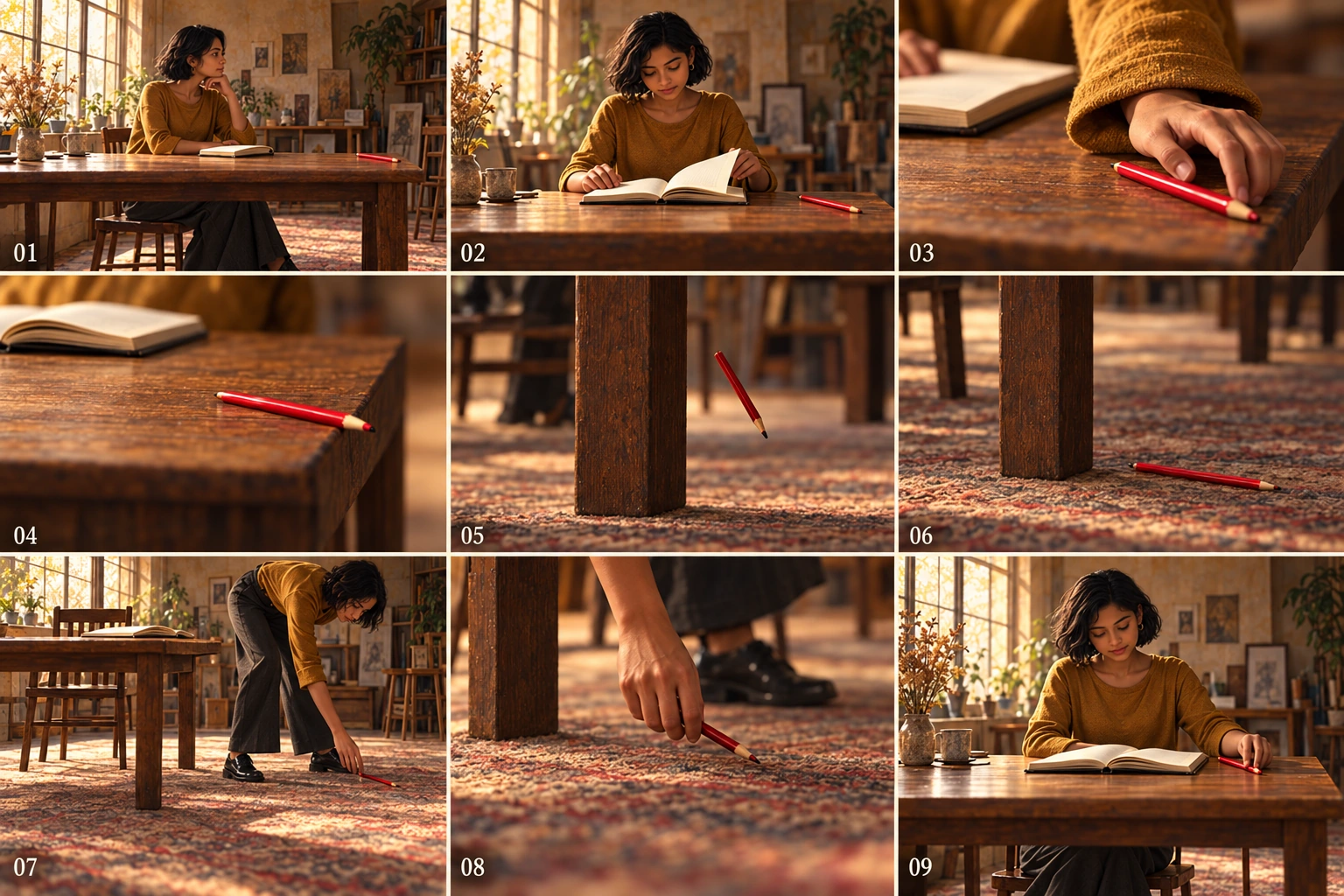
Codex 生成教学候选。偏差属于插图,不是 EveryGen AI 测试结果或 EveryGen AI 失败率测量。
检查第 03 格原因
EveryGen AI 审查时,区分意外衣袖接触与候选看似主动手指推。
在指令修正原因;要求“更自然的手”不指定目标接触。
跟随第 05 至 08 格下落与捡取
教学候选保留桌腿右侧下落与落点,以及 Mira 向其移动。在 EveryGen AI 修正第 03 格时,保留这些关系。
在 EveryGen AI 分镜中,沿桌腿参照跟随下落、落地、伸手与捡起。近裁剪改变构图,不应移动铅笔或留下副本。
跟踪全部九格物件状态
EveryGen AI 审查中,独立于 Mira 跟踪铅笔:
桌面 → 衣袖接触 → 滚动 → 下落 → 地板 → 空手伸向它 → 手中 → 桌面。
然后检查 EveryGen AI 笔记本:01 合上,02 起打开。
审查完整 EveryGen AI 序列有无重复铅笔、无法解释的合本、服装变化、多肢体或移动家具,即使只有一格明显错误。
5. 从已保存版本做聚焦修正
保留首份 EveryGen AI 候选。切至 Image to Image,上传选定版本,或通过独立编辑入口从已有分镜表修复序列。
让 EveryGen AI 修正对应观察到的连续性问题,不与完全换风格合并。
第 03 格修正使用:
Edit the uploaded nine-panel storyboard.

In Panel 03, show the cuff of Mira's ochre sleeve making contact with the red pencil as she adjusts the notebook pages.
Keep her fingers away from the pencil so they do not push or flick it.

Preserve the panel number, the open notebook, the character design, and the overall sheet layout.
Keep the other eight panels unchanged.
Do not add objects or text.
要求 EveryGen AI 保留其他格表达意图,不锁定区域。
其他 EveryGen AI 位置错误也使用类似限定指令:
| 目标 | 请求修正 |
|---|---|
| 05:下落铅笔 | “用第 06 格落点参考。在第 05 格把唯一铅笔放在空中,位于可见右桌腿的观众右侧。保持桌朝向一致。” |
| 07:捡取位置 | “让 Mira 离开椅子,站在桌右端,弯腰伸空手向铅笔。铅笔仍在右桌腿右侧地板。不移动到桌中央下。” |
把 EveryGen AI 修订与已保存基线比较。接受前检查未针对修改的格。
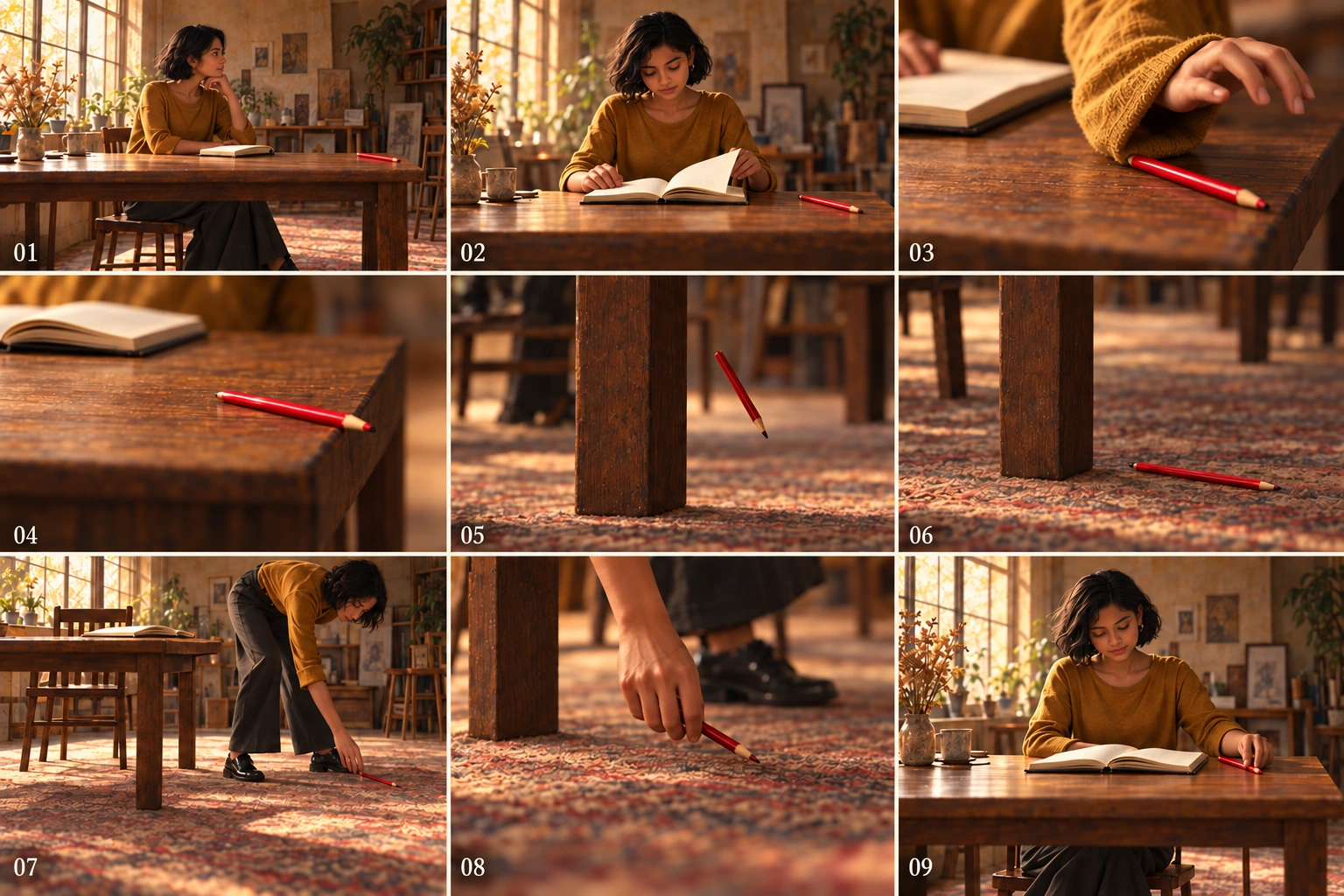
Codex 生成修订教学表。修改接触,保留下落位置与捡取序列;不是 EveryGen AI 编辑,也不证明几何与相机位置完美保留。
教学修订第 08 格手握唯一铅笔,地面清空;第 09 格 Mira 回座,旁边打开本子,桌面一支铅笔。给 EveryGen AI 候选同样状态检查。
目标格改善不代表 EveryGen AI 审查结束。接受版本前再次读完整序列。
6. 必要时在外部重建单格
局部修正反复改变 EveryGen AI 分镜可接受部分时,转外部合成,不把格子视为独立可编辑图层。
在外部沿实际可见边界裁剪最后接受的 EveryGen AI 表副本,不假定等分像素坐标。保留动作与标签,或另行排标签。
按序保存裁剪,如 01-start、02-open-notebook 至 09-return-pencil。用角色参考与具体动作简报,另行制作或绘制替换格,再在外部布局文档组装九张图。
这是手工裁剪和合成,不是 EveryGen AI 流程自动拆分功能。
EveryGen AI 裁剪只包含原像素。放大单格前检查实际尺寸;裁剪不创建新细节。
外部组装后,重新核对 EveryGen AI 序列顺序、间隔、标签、角色与完整铅笔路径。正确画面放错格,仍讲错故事。
7. 交接分镜,而非暗示视频
交接选定 EveryGen AI 表、九行动计划、使用参考与未解决连续性笔记。原版和接受版分开,重新打开导出文件。
EveryGen AI 静态表提出动作和视角,不分配时长、播放或音频。
后续节奏工作可了解带时长分镜如何成为动态分镜。该独立流程排列帧,可加音频测试节奏,不将 EveryGen AI 分镜表变成完成动画表演。
九格不代表九秒、九次切镜或九张独立生成高分辨率帧。
有人能认出铅笔为何掉落、跟随落地和捡起、确认无重复放回时,EveryGen AI 审查完成。保留书面计划解释目标构图,同时要求图片本身传达动作。